Over a week into the 2012 Paralympic Games in London and already, there has been some outstanding performances from the athletes. As it stands, ParalympicsGB are currently second in the medal table with 32 golds, 39 silvers and 41 bronzes. The majority of the British public were looking forward to the Games after the success of Team GB in the Olympics a few weeks ago. Record ticket sales ensured that this would be most spectated Paralympics in history. But the big question that still looms, is why are the Paralympics not as popular as the Olympics?
Firstly, the Paralympics do not receive a great deal of media coverage compared to the Olympics. This year saw two different channels covering the two events, the BBC for the Olympics and Channel 4 for the Paralympics. In previous Paralympic Games, the BBC had TV rights for the Games but they did not show the amount of coverage as they did for the Olympics. For Beijing 2008, the BBC provided live coverage of the Olympics, during the day for the duration of the Games from early in the morning until late at night. For the Paralympics, that was a different story.
BBC TV Coverage between the 2008 Olympics and Paralympics:
Olympics
2008
The Olympics 8-24 August
Live coverage on BBCi
2.00am-6.00pm
1.50-6.00am BBC One/BBC HD
(start times vary)
Olympic Breakfast: 6.00-9.00am BBC One/BBC HD
9.00am-noon BBC One/BBC HD
12.00-12.45pm BBC Two/BBC HD
12.45-5.15pm BBC One/BBC HD
5.15-6.00pm BBC Two/BBC HD
Games Today: 7.00-8.00pm
BBC One/BBC HD
Paralympics 2008
10am-4pm: Live coverage on BBCi
Monday-Friday: 7pm-8pm on BBC2
Saturday-Sunday: 12.50pm-4.30pm on BBC2
Source: BBC Press Office, 2008.
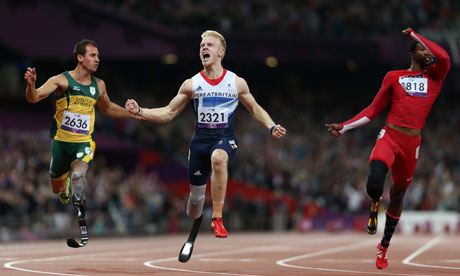
The coverage of the 2008 Paralympics wasn't shown enough for those viewers who wanted to watch the Games despite ParalympicsGB's success in Beijing, winning 102 medals overall. Channel 4 won the bid to provide TV coverage of the 2012 Paralympics where they said they would provide up to 150 hours including three extra channels for other events. So far, the viewing figures have been pretty impressive where a record 6.3 million people watched Briton Jonnie Peacock win gold in the T44 Men's 100m on Thursday evening. On the same night, 5.5 million viewers tuned in to watch David Weir claim his third gold of the Games on what was a memorable night for ParalympicsGB. With the coverage that Channel 4 has provided so far, this could be the start of bringing more disabled sport to many television sets across the world.
 |
Jonnie Peacock celebrates his victory
in the T44 100m final |
The names of most of the athletes that take part in the Paralympics are unknown to the majority of the general public. Although with the help of the Games, they can be introduced to the athletes themselves. Many people will know the 'Blade Runner' Oscar Pistorius from South Africa, who made history at the Olympics by becoming the first Paralympian to take part in the Olympic Games last month . There are a few British Paralympians who the public will remember, for instance Barroness Tanni Grey-Thompson who won 11 gold medals at the Paralympics between 1992 and 2004. Fellow wheelchair racers David Weir and Shelly Woods, are also very popular British Paralympians for their success along with cyclist, Sarah Storey. With the Games being held in London this year, it will give Britons across the country the chance to know more about them and their specific events. There are rarely any advertising campaigns featuring any of the Paralymipans apart from the build-up to the Games on Channel 4. Compared to the Olympics, the general public have seen adverts featuring athletes such as Jessica Ennis and Mark Cavendish on various adverts on products, television and billboards alike.
 |
| The 'Blade Runner': Oscar Pistorius |
With every Paralympic event, there are various classifications which define the disabilities of the athletes. It is a handful to remember from the top of your head however Channel 4 have provided a guide to help people with the different classifications. It's called LEXI which you can find more information at: http://lexi.channel4.com/. It does confuse a lot of people, although the letters are easy to figure out. A few examples include T for track, F for field and C for cycling. The numbers represent the different disabilities for example, Ellie Simmonds takes part in the S6 category where swimmers with moderate co-ordination on one side, severe impairment affecting the lower trunk and legs, those with dwarfism (like Ellie) or have the loss of limbs. The LEXI guide will only improve the knowledge of the classifications to the general public, especially to the younger generation and upcoming Paralympic fans.
 |
| Ellie Simmonds |
Now that the question has been discussed, what can be done to promote the Paralympics and disability sport as a whole? More media coverage on disability sport for a start as there are hardly any coverage of it apart from the Paralympic Games. This will get more people with disabilities into sport where there are currently one in 15 disabled adults who play sport on a regular basis compared to one in six of the overall population, according to Sport England. They have recently received funding of £2.6 million to try and increase sport participation for people with disabilities. There are plenty of role models for them to look up to such as Ellie Simmonds, who won two gold medals at the 2008 Paralympics at the age of 13. Despite their disabilities, nothing has been able to stop the athletes from competing in sport which can also improve sports participation. The ticket sales at the Paralympics so far has been phenomenal with over two million tickets sold to the public to make these Games the most spectated Paralympics in history. More of the public should give watching the Paralympics a chance, which can also help change the perception of disability. LOCOG reported that 205 World Records have been broken so far with three days to go of the London 2012 Paralympic Games.
Finally, I'll finish off with a quote from Oscar Pistorius:
"You're not disabled by the disabilities you have, you are able by the abilities you have."
 Over a week into the 2012 Paralympic Games in London and already, there has been some outstanding performances from the athletes. As it stands, ParalympicsGB are currently second in the medal table with 32 golds, 39 silvers and 41 bronzes. The majority of the British public were looking forward to the Games after the success of Team GB in the Olympics a few weeks ago. Record ticket sales ensured that this would be most spectated Paralympics in history. But the big question that still looms, is why are the Paralympics not as popular as the Olympics?